Conduent Post #4: Marketing Data Flow Diagram

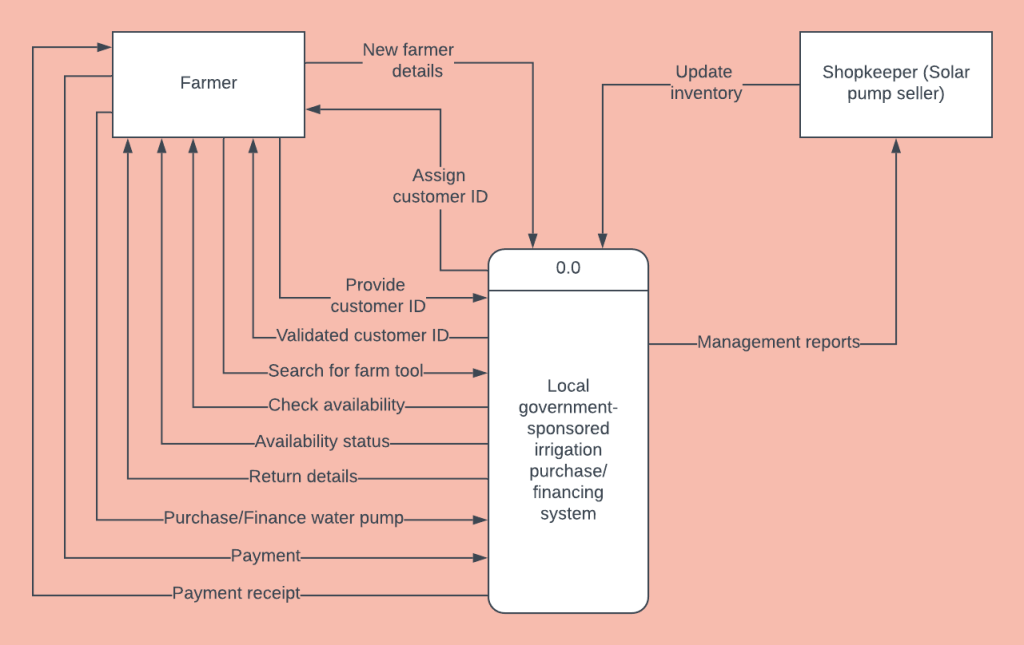
Figure 1 represents a marketing data flow diagram that incorporates local government resources and links them to the solar-powered water pump seller and farmer.

Figure 1. Marketing data flow diagram for solar-powered water pumps sold through local government to farmers in India.

The above system not only gives an overall model for how local government would interact with farmers and retailers. It also provides an idea of how all these systems would interface and share information. This is critically important to achieve business intelligence solutions. Not the least of which is monitoring participation in the program and comparing that participation to things like profit change over time.

Post #5 in this series explores a quantitative data analysis.

Conduent Post #3: Product/Service Analysis

An example of products/services Conduent could provide to Indian farmers would be tools and procedures to make farming more efficient and productive. This would entice farmers to pay over time for products and services that would make them more profitable. It would also entice local governments to invest resources and budget into providing farmers with such products and services to help its citizens and make the area more profitable overall.

For example, research into solar water pumps for irrigation in India specifically has proven to provide ease of use and affordability options to farmers to enhance their production and satisfaction (Green, Gandhi, Ilten, etc., 2017). Conduent could even choose to partner for local governments instead of directly with farmers, since it already has so much experience developing practical, local government solutions. And the business force currently employed by Conduent in India could lead this effort.

Post #4 in this series explores a marketing data flow.

Conduent Post #2: Expansion Analysis

Conduent needs to find any and all opportunities to reverse its negative profit trend and strengthen its position in the industry. In other words, it must find a way to reposition itself as a leader and innovator in the professional services industry. Up until now, Conduent has focused on business-to-business sales and solutions that focus on urban areas, particularly in international markets. While this has maintained a high level of profit, revenue continues to decline. Therefore, it’s time for Conduent to explore new avenues.

                      The best avenue for expansion in the current global marketplace is in India’s countryside. As background, India is the second largest country in the world with more than a billion people, most of which live in rural areas scattered throughout the countryside in 6 million villages (Black, 2012). Additionally, most of rural India is semi-literate, largely poor, and living in less developed land (e.g., unpaved roads and no electricity).

                      While it may seem like this community would not be a good market, this couldn’t be farther from the truth. Farmers in the countryside have resources that are evolving, and their ability to pay for solutions that enhance their production is increasing. This would be particularly true if Conduent was willing to develop solutions that farmers could pay for over time.

                      And the solutions to market to these farmers could be developed by the urban professionals already employed by Conduent. Conduent is in the unique position to already have a significant presence in Indian cities and territories like Kochi, Bengaluru, Noida, Gurgaon, and Hyderabad. These professionals, who are well-versed in creating business intelligence- and data driven-solutions for practical business and government problems, can develop similar solution for Conduent to sell to farmers in India.

                      Post #3 in this series explores the products and services that could be offered.

Conduent Post #1: Company Profile

Conduent, Inc., hereafter referred to as simply Conduent, is (according to its website) “one of the largest business process companies in the world” (Career Opportunities, n.d.). This professional services company touches on many sub-sectors including accounting, architectural services, engineering services, legal services, and management consulting. As a publicly traded business process consulting firm, it divested from multi-national print and digital document products and services company, Xerox, in 2017 (Macrotrends, 2019).

                      Unfortunately, since 2017, Conduent has experienced a downward trend in stock price (MarketWatch, 2019) despite an upward trend industry-wide over the past year (Professional services industry performance, 2019). Conduent has also experienced negative quarterly growth since divesting (Macrotrends, 2019). Consequently, the market share is quite small, especially when you consider the divestment from the giant Xerox.

                      Conduent’s competitors are Sykes Enterprises, Convergys, Cognizant, Teleperformance, and Accenture. And like these competitors, Conduent offers a variety of services aimed at businesses and governments attempting to be more efficient, enhance their impact, and evolve their technical capabilities. These services include interaction management platforms, end-user engagement services, operations efficiencies, data/payment solutions, human resources administration, and navigating legal/regulatory environments.

                      Post #2 in this series explores an expansion analysis that could help Conduent strengthen its market position by expanding into a new market.